Showing posts with label comics. Show all posts

Thursday, 24 March 2016

Darkness and Light

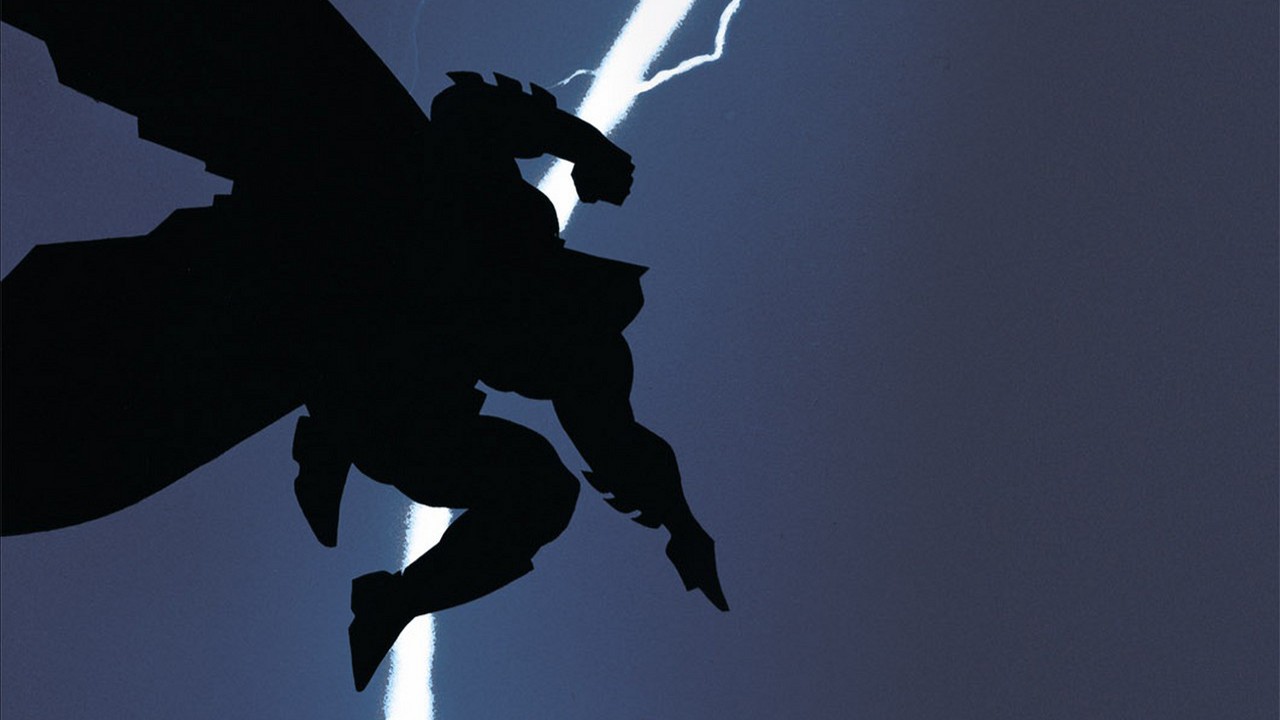
Frank Miller's iconic cover for Batman: The Dark Knight Returns #1
People remember the Eighties for Miami Vice pastel colours, Madonna in her "giant hair bow" incarnation, and Michael Jackson in a red leather suit dancing with a horde of zombies. Ronnie Reagan was the President of the United States, smiling that harmless smile that said nothing bad could possibly happen on his watch (and if it did, well, he didn't recall it). It was a decade of silly pop energy and shoulder pads.

But around the mid-point of the 1980s, there was a darkness gathering in the comic book world.

Monday, 8 September 2014

Campaign Workshop: Gaming the Nolanverse (Part One)

It's no secret that I loves me some superheroes, both on the comic book page and at the game table. And as a moviegoer, it's been an embarrassment of riches the past few years for superhero fans -- these days Marvel is hitting it out of the park, but the current Renaissance began, for me, with Christopher Nolan's dark, realistic take on Batman.

The Dark Knight was in pretty dire shape as a movie franchise before Nolan took him over, made increasingly ridiculous by a series of Tim Burton and Joel Schumacher movies. The former couldn't be bothered with more than creative design work, ignoring the fundamentals of story and character. Schumacher couldn't even manage the visuals. When I heard another adaptation was on the way in 2005, I was skeptical at best. My heart had been broken too many times.

Nolan got it. He understood that the Batman comics were not about bizarre villains and design aesthetics, they were about Batman. The main character's dark obsessions have been fascinating for almost a century, and yet in the 90s films Batman is almost a non-presence, a second banana to lesser characters like Vicky Vale and villains that are alternately comic and creepy. Making Batman the solid, emotional core of the films and setting his story against the background of a Gotham City that seemed real and contemporary, not merely a collection of baroque matte paintings, was the first of many good decisions that make the Nolan movies so great.

So of course I've given a lot of thought to what a Christopher Nolan-like superhero game might look like. (And sound like: Another great decision was using Hans Zimmer to craft a memorable soundtrack. But I digress.)


The foundation elements of making a game like this work are not trappings like realistic combat, so much as the acknowledgement that this would indeed be a High Trust, High Drama game -- one that's all about getting deep inside the heads of the characters and examining the reasons why they do the things they do. The second would be an acknowledgement that this game demands a certain serious-mindedness from all the players involved. Although a lot of games have their comedy digressions, that could be poison to a Nolanverse game -- everyone would have to be on board with the idea that this is serious business.


Another important element is working out the "realism" of the game so that all of the players are on the same page. Saying 'It's like Christopher Nolan's Batman movies' is fine, but as always the devil's in the details -- especially if all the player characters are going to be superheroes. Do they wear costumes? If so, are they all basically jet black S.W.A.T. team outfits like the Bale Batman wears? How realistic are the gadgets that they use to help them fight crime? Where do they get these wonderful toys, if not from a billionaire's mad money? Importantly, if you're talking about a group of obsessed vigilantes, do they even work together at all?

Two options that might solve the too-many-nuts-in-long-underwear-to-take-seriously problem might be a) getting the players to work as a team but possibly not put all of them in combat -- it may be that they take turns wearing the cowl, which the criminals / public assume is all one person, or (if players are okay with it) some of them are straight-up support to a single vigilante (as on the TV show Arrow); the b) option would be to take a SMALLVILLE RPG approach to the material, where the players take on the roles of supporting cast and villains rather than simply play the heroes. This would be a game where you'd have someone maybe playing a Commissioner Gordon type, someone as a romantic interest for the hero, and possibly someone taking on the role of nemesis.

You can also plug all of these important roles into the extended cast of the game by using an ensemble style, where each of the players takes the part of at least one supporting character in addition to their "lead". Elizabeth Sampat's excellent BLOWBACK RPG does this elegantly, having each player take on one 'professional' and one 'civilian' in the Burn Notice mold, to create a delicate balance of personal and professional entanglements.

It should go without saying that Batman wouldn't be the same without his Gotham City, and that Nolan did a lot of work establishing it in his movies as a realistic place. Gone were the claustrophobic, overdesigned sets of the Burton days in favour of shoots on real city streets. I think this approach is very important to grounding a Nolanverse game, and if it were me I'd set it in a real world city entirely (like Chicago, where The Dark Knight was filmed) rather than a fictional one. Or else call it by a fictional name but use a lot of real-world detail from a "model" city.

To be continued...

Tuesday, 31 December 2013

Bonus: Best Comics of 2013

I haven't written about comics here in a while, and I thought this might be a good opportunity to talk about the best stuff I've been reading this past year.

So, without further ado...


Astro City. I've been a big fan of Kurt Busiek and Brent Anderson's superhero comic with a difference since it first came out. It's a great inspiration to me in gaming, because it's entirely character-focused, rather than spending all of its time on the big spectacles (the fights, the giant aliens, the gods, the crossovers) that often distract the Big Two publishers. It's still great after all these years.


Pulp Dynamite! Dynamite Entertainment has quietly been knocking out a lot of great comics lately, and a lot of the time I buy more of their books than anyone else. Why? Because I'm a sucker for the great pulp heroes, and Dynamite has acquired the rights to a lot of the big names -- the Green Hornet, the Shadow, the Spider, and now the granddaddy of them all: Doc Savage. They're all solid books, with good creative teams working on them (Mark Waid's Green Hornet and Matt Wagner's The Shadow: Year One are particularly great) but my favourite is probably King's Watch by Marc Laming and Jeff Parker. Parker manages to give us the definitive modern characterization of the old "Defenders of the Earth" characters -- Flash Gordon, the Phantom, and Mandrake the Magician -- wrapped up in Laming's gorgeous art. This guy deserves to be a superstar. If you like your heroes pulpy, check out Dynamite.


Everything's Comin' Up Chaykin! After a long period of turning out work for the Big Two, an old favourite of mine -- Howard Chaykin -- really swung his output into high gear this year. His black & white Satellite Sam (written by Matt Fraction, but it's Fraction channeling Chaykin's signature style) is a return to greatness -- a sordid tale of the early live era of television, sex (of course), and murder. Chaykin's art is terrific, and he's the perfect man to render this world of jazz clubs, dirty deals, and leggy dames. Image released this one, as they did an older piece of Chaykin's that I'd never heard of: Century West, a rollicking tale of the West in its final days, when the frontier was quickly disappearing. The art in this single volume gem is absolutely beautiful, and it's full of Chaykin's witty dialogue. Thanks for giving the world more Howie, Image!


New (Old) Teen Titans! I think it probably came out last year, but it was new to me -- Games, a long, long, LONG gestating New Teen Titans graphic novel by George Perez and Marv Wolfman. Reading this book was like a trip back in time, and I was quickly reminded of what made NTT and Uncanny X-Men great books, back in the day -- like Astro City, they used to be about characters. It's sad to me now to see how far the mighty X-Men have fallen, into a trackless sea of pointless "events" and new costumes. Marv & George show us how to do it right, with a story that is as moving as it is tense and dangerous. Thanks for this one, guys; it was worth the wait.


Fearless Defenders, We Hardly Knew Ye. One of the year's biggest surprises was Fearless Defenders, by Cullen Bunn and Will Sliney. Yes, this was a big, over the top action book full of team-ups and slugfests, but at least this book had a new twist on the formula: it was a book all about the female characters of the Marvel-verse. I've long been a proponent of the "Why can't women just kick ass?" argument, something that is sadly still necessary to point out about the comics landscape of 2013. Here we have a huge roster of Marvel's awesome women characters going on rollicking adventures around the world, cracking wise and kicking faces in. An absolute delight from beginning to end, featuring a wide variety of Marvel women who deserve more attention: the bionic badass Misty Knight, Valkyrie (who got a very dark makeover here, in addition to a new Don Blake style arrangement with a mortal lover named Annabelle), and Dani Moonstar to name a few. Perhaps the high point of the series was an issue that shifted the focus to the heroines' male acquaintances, who have gathered in a bar to talk about how worried (and jealous) they are about their lady friends going off on exciting adventures without them. They are hilariously put in their place by the bartender, who turns out to be a long-forgotten heroine from the early 80's, Shamrock.

Fearless Defenders was not a deep or philosophical book, just a rollicking good time with a message. Of course, it was cancelled after issue 12. It will be missed.


Knights Hits 200. And speaking of books that don't get enough love, Knights of the Dinner Table hit 200 issues this year. That's nearly 20 years of indie goodness from the little company that could, who have now become the makers of unapologetically Old School games like Hackmaster and Aces & Eights. KODT is a comedy comic book about gamers, but that's just the surface of what has become a rather broad and complex affair over the (many) years. The cast has become massive, and the storylines have grown long and complex. It's still a burlesque of gaming-gone-bad, but there is enough genuine warmth and truth in this book that it's not a one-joke affair. The characters have genuinely grown over the years, and the book has grown with them in addition to cranking out the laughs. Oh, and for grognards like myself, the recent addition of Larry Elmore's SnarfQuest as a back-up feature is just the icing on the beholder-shaped cake.


That's it for 2013 from HTHD Central! Happy New Year, gamers and comic lovers!

Sunday, 2 June 2013

Swords & Sorcery & Space Cruisers: DREADSTAR

I'm skipping ahead a bit, because there is still one more "major" title to talk about on the list of Good Old Stuff that emerged from First Comics in the early 80's, but that's because today I'm going to talk about one of my all-time favourites.

A little context first. Jim Starlin began to make his mark on the comics world in the 1970s. His surreal, metaphysical space opera takes on characters like Adam Warlock and Captain Marvel (who he would ultimately kill off in Marvel's first graphic novel, The Death of Captain Marvel) laid the foundation for much of his later work, and changed the Marvel Universe in profound ways -- especially in the stories he wrote about one of Marvel's arch-villains, the Mad Titan Thanos. Yeah. When he shows up again in an Avengers movie, you can thank Jim.

Dreadstar - The Graphic Novel
It's hard to imagine now, but Marvel had a creator-owned imprint called Epic Comics in the early 80s  (edited by the late, great Archie Goodwin) that published a wide variety of interesting and more adult-focused titles like Steve Englehart's Coyote, Elaine Lee's Starstruck, Sergio Aragones's Groo The Wanderer, and of course its premiere title, Dreadstar. In addition to allowing creators ownership of their work, the line was not subject to the Comics Code Authority, and so were able to produce material with more adult themes. The books were mostly produced on higher-quality paper and could only be had through direct sales at comic shops or subscriptions. (It now seems amazing to remember the days when newsstand comic book "spinners" at convenience stores were the primary means for comic book fans to get their books.)

Back to Starlin. Jim had begun the story that would evolve into Dreadstar in Marvel's Metal Hurlant-esque SF magazine Epic Illustrated. In a galaxy-spanning yarn called The Metamorphosis Odyssey, Starlin told the tale of a small group of rebels battling an oppressive galactic empire (there was a lot of that going around in the late 70s). Unlike other small bands of rebels, however, their solution to the problem is monstrous: eliminate the enemy utterly by using a doomsday weapon to destroy the entire Milky Way galaxy. The only survivor of this battle is a fierce warrior from a polar world called Byfrexia with a magic sword -- Vanth Dreadstar.

Starlin continued the story of the Metamorphosis Odyssey in the Dreadstar graphic novel, which picked up where the battle had left off -- Dreadstar awakens, wounded, on a agricultural world at the edge of another galaxy. He makes a life there with the evolved feline-human hybrids who farm the world, and marries a human woman living there.

He eventually makes a friend -- another visitor to the world, a weird-looking wizard named Syzygy Darklock (who Starlin introduced in a stand-alone tale called The Price). Dreadstar finds the wizard agreeable company, but his drinking buddy often seems to steer the conversation toward things that resemble the "bad old days". He urges Vanth to get involved in the ongoing, destructive war between two empires -- the Monarchy  and the theocratic Instrumentality. Vanth is having none of it, but his happiness is short-lived, as the world is attacked by Monarchy forces. Vanth's wife is murdered, and he swears revenge. He assassinates the ruler of the Monarchy, installing a weak king in his place.

Dreadstar hits the ground running.
As we begin the series, Dreadstar and Syzygy are scheming to bring an end to the war, crippling or destroying both of these cruel empires that grind up innocents in their endless battles. They have gathered up a small but deadly band of rebels to fight their war, including the last surviving cat-man from Dreadstar's adopted homeworld, Oedi; a lunkish but canny smuggler named Skeevo; and a blind "cybernetic telepath" named Willow. Dreadstar's rebellion hits the ground running by robbing an Instrumentality space station that holds a chunk of the empire's treasury.

Although they are able to manipulate the weak king of the Monarchy, the rebels face stern opposition from the leader of the Instrumentality, the formidable Lord High Papal. The Papal is truly ruthless, a mighty sorcerer who does the work of strange alien gods. He hounds Dreadstar's rebels with a succession of deadly enemies, including sorcerous Cardinals, bounty hunters, and agents like Infra Red and Ultra Violet who have strange powers. (In the latter case, IR and UV got their powers from an Instrumentality bomb dropped on their home city of millions in an attempt to kill Dreadstar and Darklock. When she learns the truth, Ultra Violet joins the rebel band.)


The series has many exciting twists and turns, which I won't spoil for you here, except to say that -- unlike many stories in the comic book world -- the battle between the rebels and the Papal eventually reaches a climactic conclusion. Our heroes are put through the ringer on the way to the war's end, and not all of our heroes get there alive.

Dreadstar is a rousing adventure tale, but it would have faded with the years if that was all it was. The thing that made it riveting reading back in the day was the difference in tone in this book, compared to others of the era (and indeed others of the Epic line): there was a sense that, from the beginning of the series, Starlin had set the stakes as high as they could possibly be -- cosmically high, of course, but without losing sight of the many lives that hung in the balance when Dreadstar made a decision. This was a comic book about war, and about the ugly consequences of war, and the ugly decisions that "heroes" have to make to serve a greater purpose.

Dreadstar & Co. battle a horde of Starlin's signature mandroids.
Yes, I would call it a superhero comic of sorts -- our heroes have strange powers and wear brightly-coloured costumes. Vanth himself eventually adopts an outfit that is unmistakably a superhero costume. There are big set-piece battles against armies of weird foes, breathless chases, and the sort of cosmic weirdness one would expect to see in a book like Silver Surfer or the aforementioned Captain Marvel.

This was one of the first superhero comics that treated its subject with a serious mind, however -- the threat of cosmic genocide or war atrocities was never far away, and there was a real sense that the heroes were paying a price for the rebellion that they spearheaded. In a way, Dreadstar is like Star Wars if you let the camera linger a little longer over the consequences of some of the boffo action sequences; "Star Wars Is Hell", if you like. The idea that war is a bloody, self-perpetuating thing -- often justified or propped up by things like religion -- haunts every page of Dreadstar. (Weirdly, Dreadstar's brightly-coloured heroes somehow seem to have aged more gracefully than Epic's other space war saga, Alien Legion, which I also loved back in the day. Alien Legion somehow seems too tame and mild today to take seriously, while Dreadstar still packs a narrative punch.)

It's not as dark as something like Frank Miller's Born Again or The Dark Knight Returns or Alan Moore's Watchmen, but you can see the seeds of those great works being planted here.

Vanth takes on the Lord High Papal. Note Dreadstar's new costume.
Eventually, Dreadstar was to leave Epic Comics for a new home at First Comics. My understanding is that this was due to a struggle with Marvel over reprints of Dreadstar that they had begun, in a cheaper format, called Dreadstar and Company. The series didn't enjoy as long a run at First, and after Starlin wrapped up his epic tale of the Monarchy-Instrumentality war, the writing chores were handed over to the capable Peter David.

Starlin went on to do much more cosmic adventure, including DC's Cosmic Odyssey and the Infinity Gauntlet series from Marvel, and personal creations like The Weird and Breed. After many years of silence on the Dreadstar front, there is a rumour that we might at last see another new chapter in the saga. Starlin's Dreadstar and Metamorphosis Odyssey material is finally back in print through SLG and Dynamite Publishing. You can find these reprints -- and often, the original issues -- at your Friendly Local Comic Book Store. Check 'em out.
Thursday, 18 April 2013

A Storm Over Eden: JON SABLE FREELANCE

Sometimes when you meet your heroes, it doesn't work out the way you imagined it. I remember standing out in the rain on a dreary Montreal afternoon waiting to get my book signed by William Gibson, a writer I had huge admiration for, then not being able to say a single word to him when the moment of truth finally arrived. When I got a chance to meet George Romero at a convention in Toronto a few years back, I made a point of telling him how he was a hero of mine -- a title he humbly refused to accept -- because I had never forgotten that disappointing day in the rain so long ago.

Other times, your heroes pretty much seem exactly like you'd imagined them. In the case of Mike Grell, when I had a chance to meet him at the Motor City Comic Con, he turned out to be a larger-than-life figure as exciting and charming as any of the comic book characters he wrote and drew.

I first ran into Mike Grell's work in the 1970's, when he was probably best known for doing Legion of Super-Heroes. I found his stuff in an issue of Secret Origins, where he had done a re-telling of the origin of Green Arrow. (GA was always a favourite character of mine, and this was probably the beginning of that love affair. The story stuck with me, even though I was so young when I got the comic that I mostly used it to draw on with a big red marker I found somewhere. You can imagine how happy it makes me to have a surprisingly good TV series about him on the air right now, even if they seem embarrassed by the character's name for some reason. But I digress...)

Grell was one of the many comic book creators who decided to try their hands at creating their own new characters under the aegis of First Comics, in the early 1980s. I have written about many of the other great First books here, including American Flagg!, Grimjack, and The Badger. Mike happened to write and draw the one that is still my favourite First book, after all these years, and probably my favourite comic book period. That is no small feat, because as anyone who's helped me move can tell you, I have a lot of comics squirreled away in my basement. A lot.

Cover to first issue.
The book was called Jon Sable Freelance. It featured the adventures of a dashing but troubled mercenary named Jon Sable. Although Sable went into action wearing a "battlemask" of black combat paint on his face, he was no super hero. By turns, Sable owed the tenor of his stories to characters like James Bond, Mike Hammer, and the heroes of jungle adventure serials. Like John Gaunt, Sable was a "Jack" of all trades -- in his time, he had been a soldier in Vietnam, an Olympic pentathlete, a big game hunter, a mercenary in Rhodesia, and finally a famous soldier of fortune paid to go on adventures around the globe.

But here comes the twist. Sable, like many comic book heroes, leads a secret double life. In his case, his public persona is the globetrotting adventurer with the flamboyant battlemask and the custom Mauser. His secret identity is as the author of a series of children's books about leprechauns living in New York City's Central Park. Before embarking on a life of adventure, Sable wrote and tried to sell his autobiography -- he failed, but one publisher, Eden Kendell, liked the section of the book where he recounted the stories he used to tell his children. Sable agreed to publish them under a pseudonym, then found himself trapped -- the books were making him too much money to quit. So the fierce mercenary must occasionally don a blonde wig and fake moustache to hit the talk show circuit as kiddie writer B.B. Flemm.


If Sable was most other comics, it would end there -- with an action-packed central character and occasional comedy interludes. Where JSF was ahead of every other book on the shelves at the time, and most books since, is in the development of realistic characters with depth and complexity.

Sable has an early encounter with Flemm's artistic partner, a tall, self-possessed woman named Myke Blackmon who's dissatisfied with the arms-length working relationship she has with the author. Soon enough, she discovers Sable's dual identity, and they feel a spark. Myke doesn't understand how a man who can tell such warm children's stories can lead such a violent life, though, and a conversation with Eden leads her to the manuscript for Sable's autobiography -- and the tragic story of his family's murder.

Myke knows that Sable is a dangerous, self-destructive character to get involved with, but despite her best intentions, she finds herself drawn to him. And this doesn't happen quickly, but over the course of two years of stories. In the meantime, Sable jumps into the sack with any number of "Bond Girl"-esque supporting characters, but remains haunted by the loss of his wife and children. When he and Myke are finally drawn together, there is a real question whether together they can heal the deep wounds inside Jon Sable -- or whether he will take her down with him when he finally manages to destroy himself.


In the late 1980s, Grell left Jon Sable to return to DC Comics, where he revived Green Arrow in a beautiful painted volume called The Longbow Hunters. Although he didn't draw the interiors for the GA monthly that followed, which was aimed for adult readers (like Sable), Mike handled the writing duties. For those of us who missed him on Sable (a handful of not-even-close writers and artists tried to follow him and failed) there was a nice nod to the character in an early storyline. GA meets and fails to save a suicidal mercenary who bears more than a passing resemblance to Jon Moses Sable. Perhaps that was a shot at First Comics, who are by now infamous for burning their bridges with all of the talents who built their company, and perhaps it was Grell expressing his dismay at the Sable television series.

Yes, dear readers, there was briefly a Sable TV series that was produced by uberfan Gene Simmons -- who was in fact originally supposed to play the title character himself. The series managed to screw up pretty much everything that made the character memorable and unique, and it's best that it faded away. If you're really, truly perversely interested, you can dig up the pilot on YouTube.


The good news is that that wasn't the end of Jon Sable Freelance after all. Like Grimjack and Nexus, Sable was rescued from First's ownership and now Mike Grell has done several new series with the character. First, Mike tried his hand at writing a novel that retold the origin of Jon Sable for a new generation of readers. Then he produced a new comic version of the origin story called Bloodtrail. He has since followed up with Ashes of Eden, a full-throttle return to the glory days of Sable featuring his occasional partner in crime Maggie The Cat.

The original Jon Sable Freelance stories are in print again, in handsome new omnibus editions from IDW. Check 'em out.

Footnote: When I got to speak to Mike in person at the Motor City Comic Con, I asked him of all the projects he'd worked on over the years of his comic career, which was his favourite? The Green Arrow / Jon Sable fan in me was ultimately disappointed in his answer. His favourite job was his time drawing the Tarzan daily comic strip, back in the day when newspapers offered such things. Although it wasn't the answer my heart was hoping for, looking back on it now, I can see how that early, formative job put Mike on the path to Jon Sable.

Sunday, 24 February 2013

Not Just Another Pretty Face: Grimjack

Last year, I had the privilege of spending several months being paid to write. It was probably one of the best times of my life, in terms of creative fulfillment. For someone who has long dreamed of having the ability to spend each day doing the thing he loves, it was an embarrassment of riches. Also, my cat loved having me around the house every day.

As the project came to an end, I had a brainstorm and -- with the kind permission of my boss -- contacted a longtime favourite comic book artist of mine through his website. A couple of e-mails later, Tim Truman had agreed to produce a piece of artwork for the project I'd been writing for three months. I was over the moon.

Tim has been a part of my life for a long time. I first encountered his artwork in some of the early Dungeons & Dragons books and adventures. He's had a long career producing a vast number of terrific comics for a variety of publishers, including his post-apocalyptic .44 magnum opus Scout, a re-imagining of Hawkman's origin called Hawkworld, a gritty Western about Superman's adopted family called The Kents, and two excellent Jonah Hex weird westerns with (another one of my favourites) Joe Lansdale. More recently, Tim has been writing Conan and has teamed up with his son to produce a Western comic called Hawken.

But I'm here to talk about my favourite Truman comic, another classic from the early days of First, the science-fiction fantasy noir western horror epic Grimjack, drawn by Truman and written by John Ostrander.


Grimjack got its start as a backup feature in Mike Grell's Starslayer comic, which (although I love Mike's stuff) never got much love. My friend Steve once said of that comic that "It was a comic everybody read for the back-up story." The same was probably true of The Rocketeer, which got its start as a backup feature for Eclipse comics (I can't even remember what the "A" story was). Where Starslayer felt dull, hearkening back to old-style Flash Gordon-esque science fiction/fantasy mash-ups without improving on them, Grimjack had a fresh, anything goes edge.

My apologies to Mike Grell. If it softens the blow any, Mike, you wrote and drew my single favourite comic of all time, Jon Sable Freelance, and I'll be writing a column about that soon.

Grimjack is set against the sprawling backdrop of the pan-dimensional city of Cynosure, a place where all dimensions intersect and meet (something that changes like the phases of the moon) and the laws of physics and reality can change from one block to another. It's a place where small hovering "tourbots" used to explore the slums are a constant pest, and alien gods might just belly up to the bar for a drink.

John Gaunt, AKA Grimjack, knows the territory. He knows that there are times it's better to have a sword in your hand than a pistol (in case technology ceases working temporarily) and he can handily kill most people with both -- or his bare hands, if it comes to that.

Gaunt is the world-weary Chandleresque hero at the center of the tale, a chameleonic mercenary who is whatever the story demands of him: a hard-boiled detective, a gladiator, a soldier (Gaunt is a veteran of the Demon Wars that once scourged Cynosure), a thief, a sorcerer, a politician, an assassin, even (in one memorable storyline) a time-travelling cowboy. He's like the city he inhabits -- a little bit of everything, and all of it dark and cynical.

Gaunt is a killer, and he makes no bones about it. He's done a lot of bad things, and killed a lot of people. He's not a nice person. But he's loyal to his friends, brave, and like all good noir heroes he stands by his own code: "There are standards. If you can't see one, you make one and stick by it come hell or high water -- until you see a better one."

Grimjack in action.
When Gaunt is not on a mission with his mercenary buddy BlacJacMac, he drinks himself into a stupor in Munden's Bar, a seedy dive in a dangerous part of Cynosure. Gaunt's long-suffering manager Gordon keeps things quiet, the way the boss likes it, so he can quietly poison himself with rotgut in the corner with Bob the lizard. Bob drinks and smokes and talks a little, but he doesn't judge. It's worth noting that Munden's Bar had its own back-up feature in Grimjack (which likely owes a great deal to Spider Robinson's great Callahan's Crosstime Saloon books), where the colourful guests who visit the bar are introduced in more detail. Even the then-brand-new comic stars the Teenage Mutant Ninja Turtles dropped into Munden's on one of their early adventures, in an early colour appearance.

Grimjack is full of action and intrigue, by turns dark and humourous (Gaunt's adventures include a journey to a dimension inhabited by anthropomorphic "funny animals" and a turn as campaign manager for a con-man in blackface who has adopted the persona of Michael Jackson), and always unpredictable and full of imagination.

Ostrander's stories are tight and full of great tough-guy dialogue. His yarns tend toward "done in one" or short arcs of two-three issues, so the slow build over the first year-and-a-half of the series toward an epic climax (The Trade Wars, when rival interdimensional corporations are provoked into open military conflict with one another by Grimjack's old nemesis, The Dancer) creeps up on you as a surprise. The grander tale is assembled slowly, with a collection of tiny brushstrokes and pieces of backstory. And then everything blows up good.


There is much in John Gaunt that hearkens back to Michael Moorcock's "Eternal Champion" cycle (Gaunt once comments that "one poor mook" had mistaken Cynosure for Tanelorn). As the Grimjack series continued, Tim Truman left the series and a number of other artists took a hand -- Tom Sutton, Flint Henry -- and the Moorcock analogy became more overt. Further storylines followed another incarnation of Grimjack in a future Cynosure. The series was never the same without Truman's artistic touch, though -- Truman has a gift for drawing tough guys, guns, and whatever weird thugs and monsters Grimjack ran afoul of (and then ran through). Zombies, robots, assassins with pumpkin heads, vampires, the skull-faced villain Mac Cabre with his Uncle Sam style top hat and red-white-and-blue outfit -- if Ostrander could dream it, Truman could bring it to life on the page.

The good news is that recently, like a number of the other creators who made First great back in the day, the rights to Grimjack have been returned to Ostrander and Truman and they've begun producing new adventures of the original, indispensible John Gaunt. (And the original tales are back in print from IDW too, in inexpensive omnibus format. You can even get the early Starslayer shorts in the first volume.) Truman's style has changed over the years, but he still makes the weird denizens of Cynosure -- and its cloaked, scar-faced champion -- as vivid as ever. Check it out.

Sunday, 17 February 2013

Chaykin Up the Comic World: American Flagg!

One of my best friends in the world is named Steve.

I have known Steve since I was in Grade Eight, when I was invited by another friend (Rob) to join a weekly roleplaying group across the road at the high school. Steve was there, as was his brother Greg and their friend Randy. (My memory is faulty on whether our friend Chris McKinnon was part of that group or not.) We played D&D in the English room and had a lot of laughs. And the one who made me laugh more than anyone was this short guy with a thick black beard and a wicked sense of humour.

The beard comes and goes these days, but Steve still has the wicked sense of humour.

Anyway, I enjoyed Steve's company but I didn't know we were soul mates until we both happened to be on the same long bus ride - an English trip to Stratford the following year, when I'd finally made the jump from interloping grade schooler to "Minor Niner". Steve had brought a backpack full of comics, the likes of which I'd never seen before. This was my introduction to the world of Howard Chaykin's American Flagg!

Cover to Issue #1.
AF! was one of the most important titles coming out of First Comics in the early eighties (it rattled a lot more cages than The Badger, which I've written of elsewhere) when a lot of the superstars of 70's comics were seeking greener pastures outside the mainstream publishers. Howard Chaykin was probably best known at the time for his work on the Marvel adaptation of Star Wars, in addition to stuff like Ironwolf (DC), a Fafhrd and the Grey Mouser adaptation called Sword of Sorcery, Cody Starbuck, Dominic Fortune, and graphic novel adaptations of Samuel Delaney (EMPIRE) and Alfred Bester (The Stars My Destination, through Heavy Metal magazine).

Chaykin was looking to do more adult stuff than he would be allowed to at the mainstream publishers, and the material he brought to First perfectly synthesized some of the personal obsessions that drive his work. It also introduced a few of the elements that would go on to characterize the cyberpunk literary movement that was just in its infancy.

AF! is set in a world of the near future where a global economic and political collapse in 1996 has motivated the ruling elite to relocate to Mars. Now three worlds -- Mars, Luna, and what's left of the Earth -- are ruled by a fascist corporation called The Plex and their star-spangled police force, the Plexus Rangers. What's left of society on earth exists in heavily-fortified shopping malls called Metroplexes, bombarded by Plex video programming from omnipresent vid-screens, and beseiged by crazed motorcycle Go-Gangs that go nuts every Saturday night when their favourite show (a cartoon called Bob Violence) ends.

Cover to Issue #2. Note "jukebox" design.
The well-and-truly Plexed remains of Chicago are where we meet Reuben Flagg, the washed-up Martian star of a racy vid show called Mark Thrust! Flagg has been replaced by a computer-generated lookalike, and decided (out of a perhaps naive sense of patriotism) to volunteer as a Plexus Ranger on Earth. Flagg immediately butts heads with the thoroughly corrupt and mean Chief Ranger Hilton "Hammerhead" Krieger. Flagg is barely off the shuttle when a rifle is pressed into his hands and he's fighting off the Saturday night Go-gang attack.

(Aside: the crowd control drug they use to take down the Go-gangs is called Somnambutol, a sleep drug that makes a distinctive sound like a doo-wop band: PAPAPAPAPAPAOOOOOOMOW!MOW! Chaykin and letterer/logo designer Ken Bruzenak have a lot of fun with little gags like this slipped in at the margins of the panel, in Chaykin's highly-designed style, such as slightly absurd sound effects and over-the-top names of vid shows playing in the background like Interspecies Romance and White Sluts on Dope.)

Flagg survives the Go-gang attack, and discovers that he has a visitor waiting for him in his new apartment -- Gretchen Holstrum, the madam of the local Love Canal brothel. Gretchen insists on giving Flagg a warmer welcome than the Go-gangs, introducing another important element of Chaykin's future world: sex. Unlike other comic book characters of the era, Chaykin's hero is frequently shown engaging in that most human of pursuits, something that was almost unheard-of in the early 1980s. (Flagg, of course, learns the next day that Gretchen was sent to greet him by "Hammerhead" -- who taped the whole thing. Krieger offers him the Plex's universal contraceptive and antibiotic -- Mananacillin -- "kills all VD on contact.")

"So begins the first week of Ranger Flagg's five-year tour of duty, a week of unending banality, and mind-numbing vulgarity, punctuated by frequent outbursts of senseless violence." Flagg also makes the acquaintance of Chicago's mayor, C.K. Blitz (who has a pair of robot bodyguards named Bert and Ernie) and Krieger's firebrand daughter, Mandy.

What really kicks the series into high gear is Flagg's discovery that Bob Violence -- the cartoon that the drugged-up Go-gangs love so much -- is filled with subliminal messages of violence. Krieger doesn't believe him, though, and accuses Flagg of trying to get out of the Rangers as a "Section 8". Only one other seems able to see the subliminals -- Krieger's cat Raul, an unforgettable character who can talk and think like most humans, even though he's a cat. (As far as I know, no explanation for this is ever given.) Raul says that it must be something in Flagg's Martian physiology that lets him see the subliminals, but warns him not to mess with them. Bob Violence comes from the Plex, you see, "and nobody screws with the Plex."

When Mandy helps Flagg jam the Bob Violence signal, it sets off a chain of events that leads to Hammerhead's murder, the discovery of just how far Plex corruption goes, and ultimately a revolution.

Cover to Issue #12, the end of the first story arc.
So what makes AF! so seminal and unusual for its time, or any other time?

It's probably not an accident that Reuben Flagg -- and by extension, a lot of Chaykin's square-jawed main characters over the years -- resembles an idealized version of his creator. Flagg is a character with a lot more complexity than comics were accustomed to in the early 80's (and pretty much since then too), a Jewish hero that struggles with idealism and cynicism, has a number of lovers (but few long-term relationships), knows how to cook, and likes old jazz and swing music. Flagg often finds himself struggling to find the right course of action in a world that's filled with corruption, and loves his country despite that corruption. Steve once summed up Flagg's complexity thus: "He's the only character in comics with a middle name."

Although the violence and media-saturation of AF! that make it a formative cyberpunk text are prominent, so is the constant presence of satirical humour (such as the many media clips seen in the background and the various trademarked product names). The closest analogy to the world that Chaykin creates in AF! is probably Paul Verhoeven's Robocop, which embraces the same heady mix of satire and brutal violence (but perhaps lacks the subtlety of Chaykin's characterizations and the depth of his world).

Chaykin's visuals are sharp and heavily-designed, with characters rendered in great detail (with costumes that often change) using pointillism to create texture. His covers and splash pages are swingin' bursts of energy, and his page layouts are complex.

Flagg and female cast. Note Raul at bottom of frame.
Although Chaykin is often remembered (rightly) as a great artist, he's an underrated and talented writer. His scripts on AF! crackle with sharp dialogue, intrigue, and comedy. His characters are lively and sometimes indelible, in the case of Raul the cat, and later additions to the AF! cast like the grifter Sam Luis Obispo and blackmarket basketball player Jules "Deathwish" Folquet, not to mention the rightful King of England.

It should be noted that Chaykin's work is certainly chauvanist, if not actually misogynist. Chaykin's female characters are complex and interesting, for the most part, and are always the intellectual equal of the main character. Of course, he still usually manages to get most of them into bed.

The good news is that American Flagg! has recently come back into print in both softcover and hardcover collections from Image. Check it out.

Sunday, 13 January 2013

We Don't Need No Steenkin' Badgers!

Another of my pet obsessions is comic books. I've been a comic book fan -- collector is probably not the right word, because I'm less interested in keeping my comics in pristine shape than I am in enjoying them -- since I was about six years old. I suspect that everyone believes they grew up in the greatest age of (x), through the lens of nostalgia, but in the case of comic books I really did grow up in a remarkable time.

In the early 80's, a lot of the artists who had been superstars in the 1970s -- guys like Mike Grell, Howard Chaykin, and Jim Starlin -- began dipping their toes in the waters outside the Big Two publishers. Some experimented with creator-owned material (it's hard to believe, in retrospect, that Marvel once had a creator-owned line back in the day) while others just sought out publishers willing to let them produce comics that were about something other than people in long underwear punching each other in the face. That brings us to First Comics.

For a while, it seemed like every exciting, edgy comic in the world was coming out of First. Howard Chaykin brought us his sexy cyberpunk dystopia American Flagg!; Mike Grell produced Jon Sable Freelance (one of my all-time favourites); John Ostrander and Tim Truman created the immortal John Gaunt, AKA Grimjack; and Mike Baron and Steve Rude unleashed the costumed-but-decidedly-unsuperheroic Nexus.

It is another of Mike Baron's creations that I wish to write about today, an oddity (even back in the day, it was pretty odd) called The Badger.


In an age where comics off-the-beaten-track were perhaps more common, and Mike Baron in particular was writing some pretty odd stuff, The Badger was the ass-kicking mayor of Oddtown. Baron complains in an early editorial column -- which may or may not be baloney -- that he had this awesome idea to do a comic about an ancient druid, but couldn't sell it without the presence of a costumed superhero. Now that sounds more like the comic world I'm familiar with!

And that brings us to the Odd Couple who headline this excursion to Oddtown: Ham and The Badger. Ham is an ancient weather wizard kicked out of England by his wizarding contemporaries for his ambition and overenthusiastic storm-making. Taken "over the edge of the world" (to North America) in a state of suspended animation, where he won't trouble his contemporaries any more, Ham slumbers the centuries away before awakening in a Wisconsin mental hospital in the current day. Well, it was the current day back in 1983.

Ham telepathically introduces himself to his next-door-neighbour in the nuthouse, Norbert Sykes -- or at least, that's the name on his neighbour's case files. Sykes introduces himself as The Badger, and a few issues in we learn that this is the name of the largest spoke in a wheel of many multiple personalities. Sykes is a troubled Vietnam veteran who was abused as a child by his stepfather, producing a profoundly damaged human being who also happens to be a world-class martial artist with the Dr. Doolittle-like ability to speak with animals. Oh, and The Badger calls everyone Larry (the name of his deceased father).

Got that? Ham's an ancient druid transported to the modern world -- The Badger's a martial artist with MPD that can speak to the animals -- THEY FIGHT CRIME!

Well, sort of.

Ham teaches Norbert how to talk his way out of the asylum by teaching him how to give his gullible psychiatrists all the right answers, convincing them he's made a full recovery. With The Badger free to act as his familiar and his bodyguard, Ham "recovers" from feigned catatonia and checks himself out of the hospital. Using his magic, he promptly wins the lottery several times over and builds himself a small fortune. He hires his psychiatrist, Daisy, to act as his business manager (she stays on largely to continue treating Norbert) and purchases a castle where he can pick up just exactly where he left off in 412 AD, stirring up wild weather (and trouble).


The Badger, meanwhile, has made himself a costume (which is, it must be said, pretty bad-ass) and set about the business of fighting crime. Well, like I said, sort of. See, sometimes The Badger beats up street criminals like muggers, rapists, and gang members who pretty much all comics would have us believe deserve a vicious beating by someone in longjohns. The Badger, however, often administers beatings to people who are merely rude or uncouth -- litterers, drunken frat boys, and people who talk during movies, just to name a few. He is also singularly stern with those who are cruel to animals.

Looking back, this is the thing that makes The Badger an unforgettable character -- he's a spinning-back-kick in the face of superheroes in general. It couldn't be much clearer that Baron wasn't interested in the traditional dynamics of hero-meets-villain, hero-wails-on-villain, the-Earth-is-safe-once-again formula of traditional comics. Here was a costumed vigilante who basically exposed the arbitrary and absurd nature of costumed vigilantes, and, as Alan Moore would later expand on at length (in a much more dour fashion), an acknowledgement that people who did these kinds of things would have to be crazy.

And The Badger is Crazy. Capital-C Crazy.

The Badger and Ham do eventually fight some oddball characters you might call villains, such as the survivalist douchebag The Hodag (he gets turned into a weird human-turtle hybrid by a native curse), but most of The Badger's rogues gallery are semi-anonymous goons dispatched quickly so the story can concentrate on other stuff. Baron would rather show us Ham and The Badger taking on corporate goons, or comic-burning religious types, or engaging in philosophical debate over a beer. Eventually, The Badger acquires a sidekick of sorts in the ghost of Warren Oates, who passes through Norbert's life dispensing boozy wisdom.

I was lucky enough to recently find the first 15 issues of The Badger at my Friendly Local Comic Book Store for an unreasonably low price. If you happen to stumble across it yourself, it's well worth your time. The Badger is the kind of thing you don't read every day, now or back in the more-innocent-age of the early 1980s. By turns hilarious, political, thoughtful, thrilling, and just plain unlike anything else out there you're likely to read.

Check it out, Larry.